
The Calm Pet Vet

Dog behaviour

Dog behaviour consults

For the dog who screams at the end of the lead, cannot be left alone, or has started growling and you do not know why. A long, unhurried appointment with a vet who can examine your dog, rule out pain, diagnose what is actually happening, and prescribe when it helps.

90 to 120 minutes, from $680. At home across Adelaide and Melbourne, or by video anywhere in Australia.

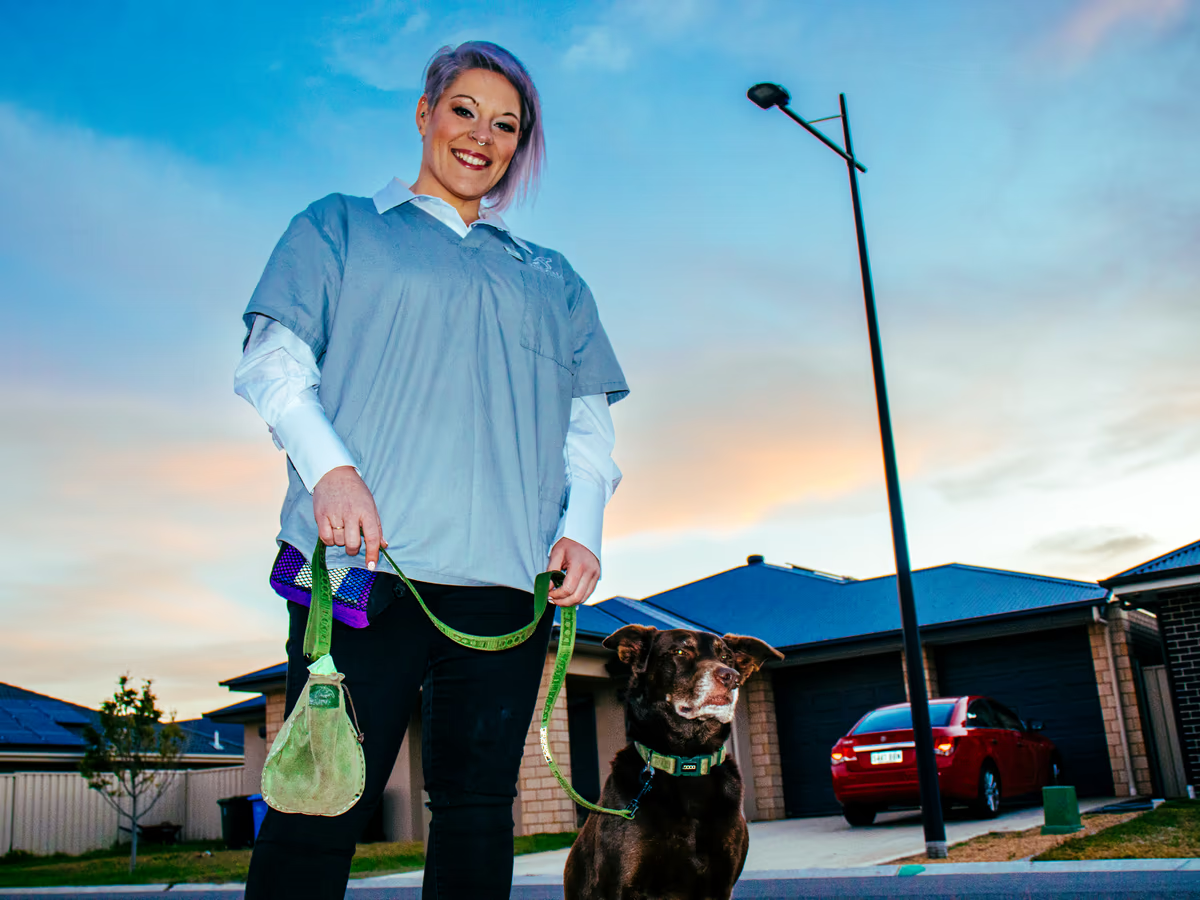
Dr Chantelle McGowan walking a dog on lead through a quiet suburban street

What we treat

The problems that bring dogs to us

Not a list of conditions with no detail behind it. This is what each one usually turns out to be, and what we do about it.

Reactivity on walks

What it looks like

Lunging, barking and spinning at the end of the lead when another dog, a bike, a truck or a person in a hi-vis vest appears. You cross the road. You walk at 6am. Eventually you stop walking at all.

Almost all lead reactivity is distance-increasing behaviour driven by fear or frustration. It is very rarely about dominance, and it is usually not aggression in the sense people mean when they say the word. The lead has removed your dog's option to move away, so the only strategy left is to make the other thing go away instead. From your dog's point of view that strategy works every single time, because the other dog does eventually walk past. That is exactly why it gets more reliable over months rather than fading out.

There are 2 very different dogs that both get labelled reactive, and they need opposite plans. The frustrated greeter desperately wants to reach the other dog, screams and pulls forwards, and settles once contact happens. The fearful dog wants distance, goes still and hard-eyed first, explodes at a set range, and will not take food anywhere near the trigger. Running a frustration plan on a fearful dog reliably makes that dog worse, so working out which one is standing in front of us is the first job, not the last.

The consult maps your dog's actual threshold distance, screens for pain (a sore dog has a much shorter fuse and lunging on a neck collar is its own pain problem), reviews equipment, and then sets a desensitisation and counter-conditioning plan run entirely below threshold, alongside a management plan so your dog stops rehearsing the behaviour daily. Where arousal is so high that no distance is workable, medication comes into the conversation, because a dog who cannot eat near the trigger cannot learn near the trigger.

Being straight with you

This is months of work, and the plan often opens with a period of not walking in the usual place. Owners hate that step. It is also the step that makes the rest of the plan possible.

Separation distress

What it looks like

Damage concentrated at doors and windows rather than spread through the house. Vocalising that starts within minutes of you leaving. Drooling, pacing, house soiling in a dog who is otherwise reliable, broken nails or teeth from escape attempts, and a note from the neighbours.

What your dog does in the first 30 minutes tells us far more than what the house looks like when you get home. That is why we ask for camera footage before the consult, even a phone propped on a shelf. It is the single most useful piece of evidence in the whole case, and it routinely changes the diagnosis: boredom, a noise phobia that happens to fire while you are out, and confinement distress all leave similar wreckage but need different treatment.

The footage also separates 3 things that get lumped together. Some dogs panic only when one particular person leaves. Some panic when left completely alone but are fine with any human company. Some are fine alone in the house and panic behind a crate door or a closed gate. Each of those is a different plan, and guessing wastes the months you do not have.

Treatment starts with safety and management rather than training, because a dog in a genuine panic state can injure themselves badly on a crate door. In practice that usually means arranging for your dog not to be left alone during the early treatment period, through daycare, a sitter, a neighbour or family. Then graduated absences, which at the start are measured in seconds rather than minutes. Medication is genuinely indicated in a lot of these cases, because a brain in a panic state does not habituate, it sensitises.

Being straight with you

This is one of the slower conditions to treat. Consistent work over 3 to 6 months is normal. Bark collars and any punishment-based approach reliably make it worse, because they add a second frightening thing at the precise moment your dog is already frightened.

Excessive barking

What it looks like

Barking at the fence line, at every passer-by through the front window, at you for attention, at night, or for the entire time you are out. Often a council noise complaint is what finally prompts the call.

Barking is a clinical sign, not a diagnosis, and the treatment depends completely on what the barking is for. Alert and territorial barking at a boundary, demand barking that has been accidentally trained by an intermittent response, frustration barking from behind a barrier, distress barking when alone, and barking driven by pain, failing hearing or canine cognitive dysfunction in an older dog are 6 different problems that happen to make the same noise.

So the consult runs a functional assessment: when it happens, at what, for how long, what makes it stop, what has already been tried and what happened when it was. Camera or audio recording matters here too, particularly for barking that only happens while nobody is home, because owners are usually working from a neighbour's description rather than the actual pattern.

Night-time barking or vocalising that is new in a dog over about 8 is treated as a medical question until proven otherwise. Cognitive decline, pain that disturbs rest, high blood pressure and reduced vision all change how a dog handles the dark and the quiet, and none of them respond to training.

Being straight with you

We do not use or recommend anti-bark collars, citronella or electronic. They suppress the sign without touching the cause, and where the cause is fear or distress, adding something unpleasant to an already frightened dog is a common route to a dog who stops warning and starts biting. Where a council complaint is involved, we can write in support of a documented management plan.

Aggression

What it looks like

Growling, snapping, lunging or biting. Directed at people, at visitors, at the other dog in the house, or over food, bones, the couch or a person. Sometimes it appears to come from nowhere.

Start here: a growl is information, not the problem. It is your dog's early warning system telling you they are not coping. Punishing a growl does not change how the dog feels, it just teaches them the warning is unsafe to give. The bite stays and the notice disappears, which is how dogs end up described as biting without warning.

The categories matter because they carry different plans and different risk. Fear-based aggression is by far the most common. Then there is pain-related aggression, resource guarding of food, bones, resting places or people, territorial aggression, redirected aggression, conflict between dogs in the same household, and predatory behaviour, which runs on a completely different mechanism to all of the above. A pain screen is part of every one of these consults, because pain lowers the threshold for all of them.

Management comes before training, always, because every incident makes the next one more likely. That means a plan that makes a repeat genuinely unlikely from day one: physical separation, changed routines, and where it fits, proper basket muzzle training conditioned positively over weeks. A well-conditioned muzzle is a welfare tool that gives a dog more freedom and more walks, not fewer.

You will get a straight risk assessment: bite history and the level of injury caused, how predictable the behaviour is, the size and strength of the dog, who lives in the house including children and older relatives, and what management the household can realistically sustain. That assessment is the part most owners are not given, and it is the part that determines whether a plan is safe to attempt at home.

Being straight with you

We do not use confrontational methods, alpha rolls, prong collars or electronic collars, and we will not recommend anyone who does. Where the honest conversation is about long-term safety in your household or your dog's quality of life, we will have it with you directly rather than talking around it.

Fear of strangers and visitors

What it looks like

The doorbell goes and your dog barks then retreats. Later they creep up behind the visitor and nip the back of a leg as that person stands up. Or they solicit a pat, accept 2 seconds of it, and snap on the third.

Most of these dogs are in approach-avoidance conflict. Part of them wants to investigate the newcomer and part of them wants to escape, and the bite happens in the gap between the 2. That is also why the standard advice, let the dog come to you and then pat them, fails so often. The dog approaching is not consent to being touched, it is the curious half winning by a nose.

The plan is a visitor protocol you can actually run on a Saturday afternoon with your in-laws in the driveway. Where your dog goes and when they go there, who is responsible for what, the exact script the visitor is given before they arrive rather than at the door, and a safe space set up in advance with something good to chew rather than improvised in a rush.

For the visitors who matter and recur, the regular friend, the cleaner, the grandchildren, we build a graduated plan to change how your dog feels about that specific person. For everyone else, your dog does not need to meet them. A great many dogs are far happier not attending their own dinner parties.

Being straight with you

For a lot of these dogs, management stays part of the plan permanently. A dog relaxed behind a baby gate with a stuffed toy while guests eat is a successful outcome, not a compromise.

Fear of the vet

What it looks like

Bracing in the car park. Refusing to come through the door. Shaking on the table, needing 2 nurses to hold them, or needing sedation for a routine vaccination. Some dogs have already been asked not to come back.

Vet fear compounds faster than almost anything else, because the whole chain becomes predictive. The lead coming out at an odd hour, the car going the wrong way, the car park surface, the smell in the waiting room. By the time your dog reaches the consult room they have already been frightened for 20 minutes, and each visit that ends in restraint or sedation confirms it for the next one.

A home visit removes most of that chain at once, which is why so much of this practice is mobile. Beyond that, we work with cooperative care: teaching your dog a chin rest or a station, conditioning handling one small step at a time, and giving your dog a genuine way to opt out. A dog who is allowed to say no reliably says yes more often, which is not a slogan, it is just how consent-based handling ends up faster than restraint.

Pre-visit medication is often part of the plan and it is not a failure. Keeping a calm dog calm is far easier than settling a dog who is already in a panic, and it means the appointment is remembered as unremarkable rather than as another confirmation.

Being straight with you

Some things need a clinic. Surgery, dentistry, hospitalisation and imaging cannot happen in your lounge room. So the goal is not permanent avoidance, it is a planned, gradual return to the clinic while your dog is well and nobody is under time pressure. We do that work with your regular clinic, not around them.

Before the appointment

What we ask you to bring

The homework is real, and it is the reason the consult can go straight to the useful part instead of spending the first 40 minutes gathering basics.

  • A completed intake questionnaire, which takes most people 30 to 45 minutes
  • Short videos of the behaviour happening naturally, filmed from a safe distance
  • Permission for us to request your dog's history from your regular vet
  • A list of everything already tried, including the things that made it worse
  • Everyone in the household who handles your dog, present if you can manage it

A note on filming your dog

Never set your dog up to perform the behaviour so you can film it. Every rehearsal of fear or aggression makes the next one more likely, and a staged clip is worth less than a genuine one anyway.

What helps most: 30 to 60 seconds of the behaviour as it happens naturally, filmed from a safe distance, plus footage of your dog relaxed at home for comparison. For anything that happens while you are out, a phone propped on a shelf or a cheap indoor camera is the most valuable thing you can send us.

Pricing

What it costs, before you ring

Published up front. Out-of-hours appointments, travel, prescriptions, medications and pathology are quoted separately, and we would rather give you a tailored estimate for your dog's exact situation.

Behaviour Counselling

In-depth behaviour consultations (Adelaide & Melbourne).

  • Extended Initial Consult90-120 minfrom $680
  • Revisit30-45 minfrom $330
  • Fear Free Training30-45 minfrom $330

All consults are Fear Free and inclusive of GST. Out-of-hours appointments, travel, prescriptions, medications and pathology testing are quoted separately. We prefer to give you a tailored estimate for your pet's exact circumstances. Travel is charged from $135.

Questions

Dog behaviour questions

Tell us about your dog

Describe what is happening and when it started. We will tell you honestly whether a behaviour consult is the right next step, what it involves and what it costs, before you commit to anything.