
General practices
Mixed-experience teams where the handling standard drifts between the vet who trained in 2004 and the nurse who started last month.
For veterinary professionals
Lunch-and-learns and webinar sessions in Fear Free and low-stress handling, built for your practice rather than delivered off a shelf. Audiences run from dog-boarding facilities through to referral hospitals, and the session changes accordingly.
Most teams already know that holding a cat down is not ideal. What they need is the alternative, in their own rooms, with the equipment they have and the appointment lengths they are stuck with.
Who delivers it
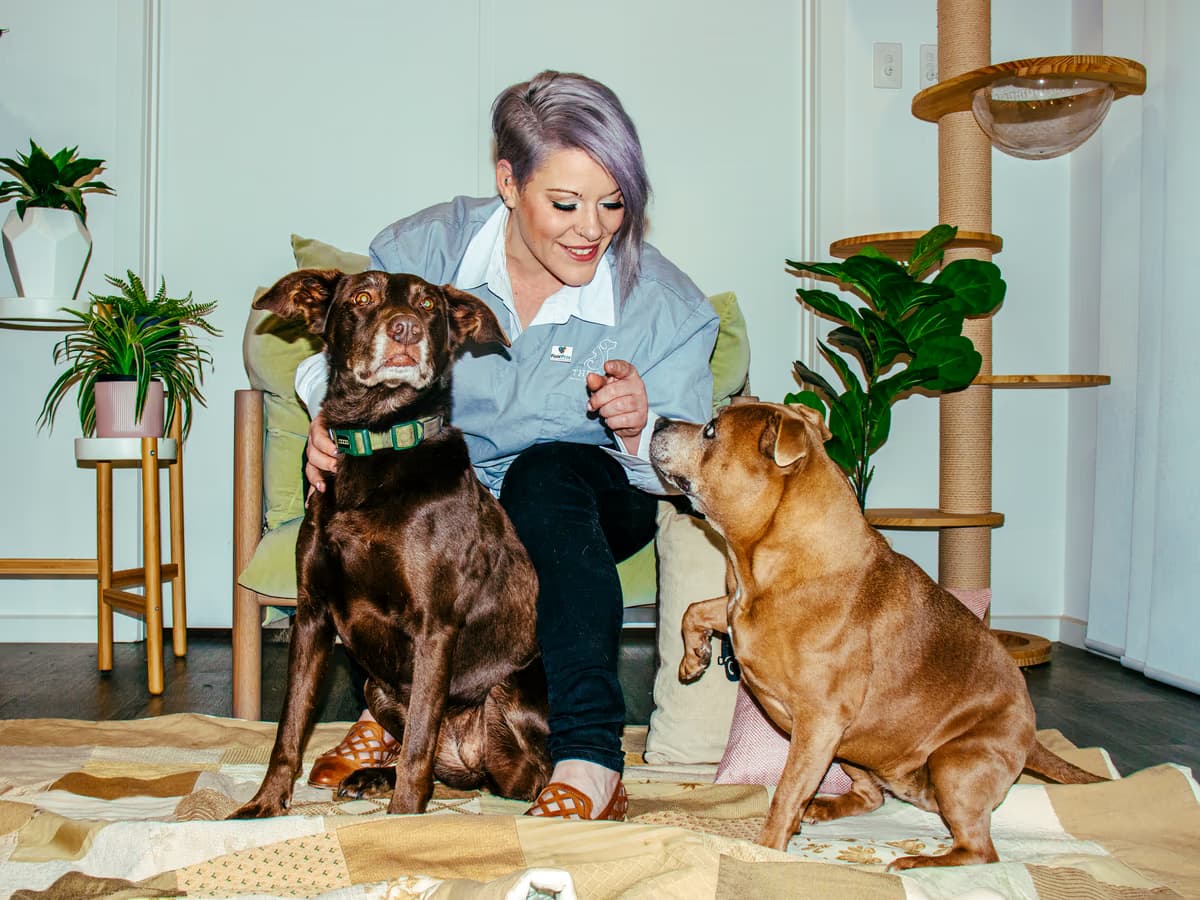
Fear Free certification is an individual credential. The Coach credential is the one that covers teaching it to a team, and it is held by considerably fewer people than certification alone. Dr Chantelle "Channy" McGowan (they/them) holds both, at Elite level, alongside MANZCVS in the Veterinary Behaviour Chapter.
They have been a registered veterinarian since 2011, previously as Head Veterinarian at an ISFM-accredited cat-friendly clinic and as a Scientific Services Veterinarian lecturing on nutrition and behaviour in Australia and overseas. The room you are training has been stood in.
Who it is for
The handling problem looks different depending on who is holding the animal and how much time they have.
Mixed-experience teams where the handling standard drifts between the vet who trained in 2004 and the nurse who started last month.
High-throughput environments where animals arrive frightened and in pain, and the team needs handling that works on the first attempt, without the slow introduction a scared patient would usually get.
Non-clinical teams handling large numbers of animals without a vet in the room, where reading escalation early is the whole job.
The people doing most of the actual restraint, who are usually last to get the training and first to get bitten.
Content
Drawn from this list and shaped to your practice. A single session takes a few of these properly rather than all of them badly.
Why practices book it
Not because low-stress handling is nicer, though it is. Because of what it does to your roster, your drug bill and your rebooking rate.
Scratches, bites and wrenched backs come out of the roster, the incident register and the insurance premium. A team that can read escalation stops arriving at the point where somebody has to be held down.
Sedation stays available for the patients that genuinely need it, rather than becoming the default for a nail trim, with the anaesthetic risk and the cost conversation that follows.
The client who leaves after a distressing visit rarely tells you why. They just do not rebook, and the pet you were worried about is now nobody's patient.
Nurses leave practices where every day feels like a wrestling match. Handling training is one of the few things that changes the texture of the work, not just the roster.
Formats
One session in your own rooms, with your own equipment and your own bottlenecks in front of us. Best when the whole team can be in the room, including reception, because the visit starts at the front desk.
Live and interactive, for multi-site groups, teams spread across a state, or practices that cannot close the floor. Removes travel from the cost entirely and works well for a night session.
The format that actually changes behaviour in a practice. Short sessions spaced out, each one building on what the team tried in between, with the awkward parts reviewed rather than skipped.
How it is built
The scoping conversation is the part that makes the session usable. Without it you get a talk about an ideal practice that none of us work in.
Quoted in writing before anything is booked. The variables are format, session length, audience size, how much bespoke material the practice needs, and travel for on-site work outside Adelaide. Webinar delivery removes travel altogether. Invoicing goes to the practice, not to individual attendees. Published consultation pricing on the pricing section covers client work and does not apply to team sessions.
A conversation before anything is written. Which procedures generate the most struggle, which patients your team dreads on the day list, what your rooms physically allow, and what your appointment lengths physically allow. A session that ignores your 15 minute consults is a session nobody can use.
A boarding facility does not need the same session as a referral hospital. Feline-heavy practices get carrier and handling depth. Practices doing a lot of geriatric work get cognitive change and pain-related irritability. Nothing generic gets recycled into your room.
Demonstration and practice rather than 40 slides. Your team brings the patient they cannot manage, and we work through that one, because a real case in your own building is what people remember 3 weeks later.
Written protocols, wording for the reception team, a stress-scoring approach that fits your record system, and 2 or 3 changes small enough to survive a busy week. Not a 40 page manual that goes in a drawer.
Straight up
A lunch-and-learn changes what a team knows. It does not, on its own, change what a team does at 4pm on a Friday with 3 patients waiting. Anyone selling a single session as a transformation is selling bull-dust.
The practices that get real change from this have 2 things in common. Someone in the room has the authority to alter appointment lengths, room allocation or the day list. And the training happens more than once, so the team can bring back what did not work and have it troubleshooted rather than quietly abandoned.
If your constraint is that consults are 10 minutes and cannot move, say so at the scoping stage. The session can be built around that honestly, which is far more useful than pretending the constraint is not there.
Tell us the type of practice, roughly how many people would attend, whether you want on site or online, and the handling problem that prompted the enquiry. A quote and an outline come back in writing.
Related